TOC
3 Security Layers Protecting Your Messages
3 Security Layers Protecting Your Messages
When you're job hunting, you might share sensitive information - salary expectations, interview feedback, or personal challenges. SpokeToWork protects these conversations with end-to-end encryption (E2E), the same security used by Signal and WhatsApp.
What Does "End-to-End Encrypted" Mean?
Simple answer: Only you and the person you're messaging can read your messages. Nobody else - not us, not hackers, not anyone.
Here's how it works in plain terms:
- Your message gets scrambled on your device before it leaves
- Only scrambled text travels over the internet and sits on our servers
- Your recipient's device unscrambles it using a key only they have
How SpokeToWork Compares to Other Apps
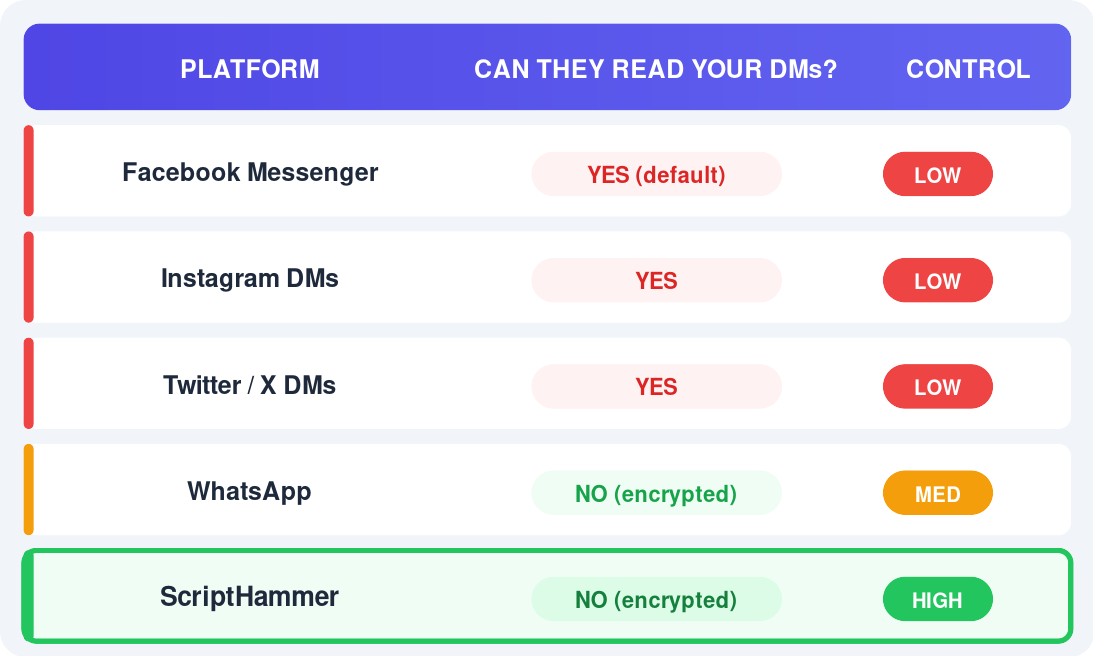 How different messaging apps handle your privacy
| Feature | SpokeToWork | Standard Email | Social Media DMs |
|---|---|---|---|
| End-to-End Encrypted | Yes | No | Usually No |
| Server Can Read Messages | No | Yes | Yes |
| Your Data Sold to Advertisers | No | Often | Yes |
| Open Source Security | Yes | Varies | No |
The Technical Details (For the Curious)
If you're interested in how the encryption actually works, here's the breakdown:
Key Exchange: ECDH P-256
When you connect with someone, your devices perform a mathematical handshake called Elliptic Curve Diffie-Hellman (ECDH). This creates a shared secret that only your two devices know - without ever sending the secret over the internet.
Message Encryption: AES-GCM-256
Each message is encrypted using AES-GCM with a 256-bit key. This is the same encryption standard used by banks and governments. Each message gets a unique random value (called an IV) so even identical messages look different when encrypted.
Password-Derived Keys: Argon2id
Your encryption keys are derived from your password using Argon2id, a memory-hard algorithm that's resistant to brute-force attacks. This means:
- Same password always generates the same keys
- You can access your messages from any device by logging in
- Changing your password rotates your keys
What We Store vs. What We Don't
| We Store | We Don't Store |
|---|---|
| Your public key (for others to encrypt to you) | Your private key |
| Encrypted message content (ciphertext) | Decrypted messages |
| Message timestamps | Message content |
| Your profile info | Your password |
Why This Matters for Job Seekers
During a job search, you might discuss:
- Salary negotiations - What you're making, what you want
- Interview experiences - Honest feedback about companies
- Personal situations - Why you're leaving, health issues, family needs
- References - People vouching for you privately
Common Questions
Can SpokeToWork read my messages?
No. We literally cannot decrypt your messages. We don't have the keys.
What if I forget my password?
Your encryption keys are derived from your password. If you reset your password, you'll generate new keys. You'll still be able to start new conversations, but old messages encrypted with your previous keys won't be recoverable.
Is this as secure as Signal?
We use the same cryptographic primitives (ECDH, AES-GCM) and the same zero-knowledge architecture. The main difference is that Signal has been audited by third-party security researchers, while SpokeToWork is newer. Our code is open source, so you can verify the implementation yourself.
What about metadata?
We can see that you messaged someone and when, but not what you said. This is similar to how your phone company can see you made a call but can't hear the conversation.
The Bottom Line
Your job search conversations are private. End-to-end encryption ensures that only you and your recipient can read your messages - not us, not advertisers, not anyone else.
Want to learn more about our security practices? Check out our Security Architecture documentation on GitHub.
Have questions about security? Reach out through our contact page.
